
Capacity for What?
When better numbers do not yet change the game.

SKILLS4ATHLETES / KNOWLEDGE
Essays and notes on performance, physical preparation, skill acquisition, coaching, data and training environment design.
I write from a practitioner’s perspective. Research helps organise the questions. Sport tests how much the answers are worth.
If this is your first visit, these essays best represent the problems I return to most often.
When better numbers do not yet change the game.
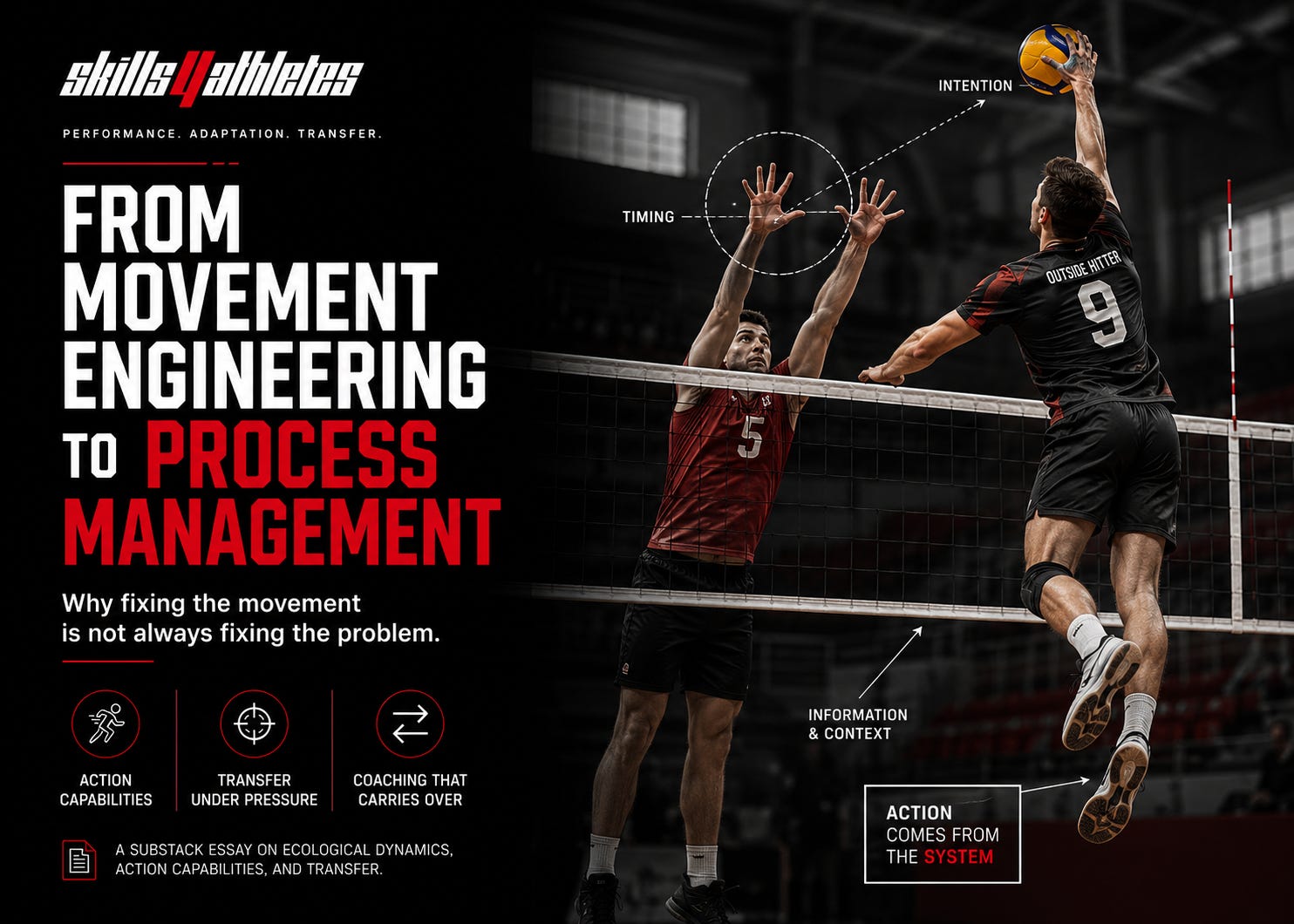
Why fixing the movement is not always fixing the problem.

What a result cannot tell us without the context that produced it.
New essays and notes appear here automatically after publication on Substack.

Learning to Work With Uncertainty

Stan zapalny ma fatalny PR…
O kontekście jako brakującym ogniwie siatkarskiej analizy
Why fixing the movement is not always fixing the problem
WHEN BETTER NUMBERS DON’T YET CHANGE THE GAME
Early in my career, I had too much respect for the hardest-working coach in the room.
Recently selected essays
When better numbers do not yet change the game.
Why fixing the movement is not always fixing the problem.
What a result cannot tell us without the context that produced it.
On coaching courage, responsibility and decisions made under the pressure of results.
Problem map
I do not organise this space around a single sport or method. Different sports impose different demands, but many questions about capability development, learning, transfer and adaptation recur across environments.
How can we develop physical capacities that genuinely expand the range of solutions available to an athlete?
How does an athlete learn to perceive information and find functional solutions?
What should a coach control, and where should they create room for adaptation?
What do we truly know, what do we merely measure, and where does interpretation begin?
Different problems require different tools. Yet there are three questions I return to regularly.
Not only what happened, but under what conditions, with what capabilities and with what information available.
Improving a test result or exercise execution matters. The next question is how it changes the athlete’s capacity to act beyond the training task itself.
Structure, feedback and intention should support learning — not replace it.
Reflections from practice
Not every essay begins with research. Sometimes it begins with a training session that did not work, a number I cannot explain, a conversation with an athlete, or a situation that forces me to question one of my own assumptions.
Those moments often lead to the most interesting questions.
Early in my career, I had too much respect for the hardest-working coach in the room.
I am not looking for simple answers. I am looking for better questions.
That does not mean every answer is equally good or that everything simply ‘depends on context’. Data matters. Principles matter. Experience matters. I simply try to remember that each describes only part of the problem.
Subscribe
From time to time, I send new essays and notes on performance, training, learning, analysis and coaching.
I publish in Polish and English — whenever a subject deserves more than a short post.
Free · PL / EN · unsubscribe in one click